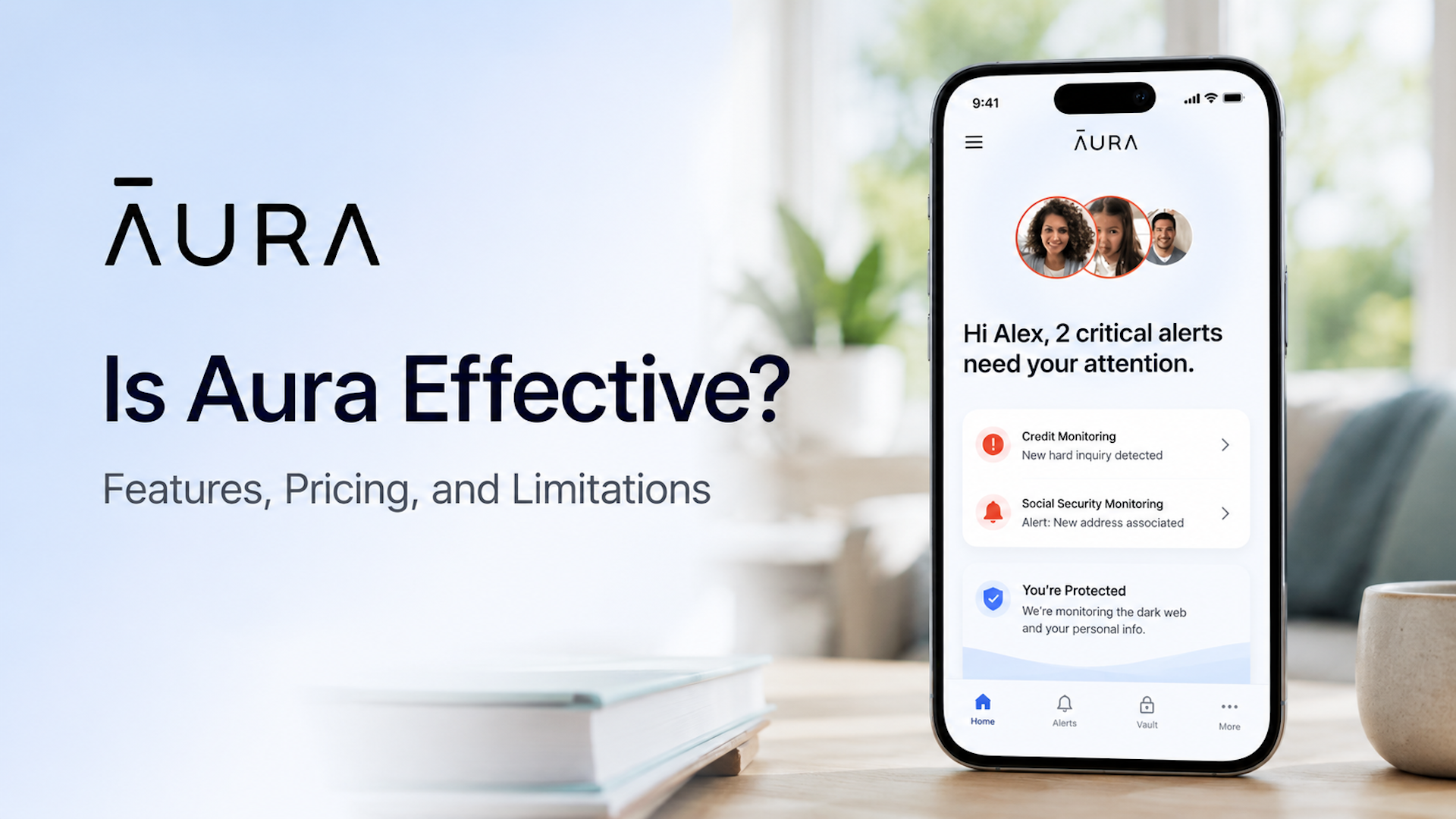
Aura is the digital equivalent of a full home security system — cameras on every corner, sensors on every window, a 24/7 monitoring team.
For some people, that’s exactly the peace of mind they’re after. For others, a solid lock on the front door would have done the job.
Let’s take an honest look at what Aura offers, what it costs, and why a simpler tool might actually help you better.
Table of Contents
What Is Aura?
Aura is an all-in-one identity protection platform designed to replace a pile of separate apps with a single subscription. It bundles credit monitoring, identity theft insurance, a VPN, antivirus software, a password manager, dark web scanning, and parental controls — all in one dashboard.
You get one service, one login, and total coverage. For some people, that’s exactly what they want.
Aura’s Key Features
Here’s what you get across most Aura plans:
- Identity theft monitoring — scans your name, SSN, passport, and personal info across dark web sources and breach databases
- 3-Bureau credit monitoring — tracks Equifax, TransUnion, and Experian for suspicious activity
- Instant credit lock — freezes your Experian file with a single tap
- Financial transaction alerts — links to your bank and investment accounts and flags anything unusual
- Dark web & data breach alerts — notifies you if your credentials turn up somewhere they shouldn’t
- VPN — encrypts your internet connection across 100+ virtual locations
- Antivirus — protects Windows, Mac, and Android from malware and ransomware
- Password manager — stores and syncs passwords across all your devices
- Online data removal — submits removal requests to 200+ data broker sites
- Spam call protection — AI-powered blocking for robocalls and scam texts
- Parental controls — screen time limits, content filtering, and cyberbullying alerts (family plans only)
- $1M identity theft insurance per adult — covers eligible losses if your identity gets stolen
Aura Pricing: Is It Expensive?
Aura offers several paid plans. Pricing can change, so always check Aura’s current pricing page before subscribing.
At the time of writing, Aura’s pricing includes:
| Plan | Annual Price | Monthly Price | Who It’s For |
| Individual | $12/mo | $15/mo | 1 adult, 10 devices |
| Couple | $22/mo | $29/mo | 2 adults, 20 devices |
| Family | $32/mo | $50/mo | 5 adults + unlimited kids |
| Kids | $10/mo | $13/mo | Parental controls only |
What Aura Does Well
1. It covers almost everything in one place
If you want one subscription to handle your VPN, antivirus, password manager, and identity monitoring — Aura does it all. No juggling multiple apps.
2. It offers fast fraud alerts
Aura claims to send credit alerts up to 650x faster than competitors, based on a 2025 study. When fraud is involved, that speed can make a real difference.
3. Strong insurance backing
Every adult on the plan gets $1 million in identity theft insurance. That’s meaningful financial protection if something serious happens.
4. Good option for families
The Family plan adds parental controls, in-game activity monitoring, and child SSN protection.
Where Aura Falls Short
1. It can feel like a lot to manage
Aura has a feature for almost everything, which sounds great until you’re staring at a dashboard full of scores, tabs, and notifications you’re not sure how to read. For people who just want simple protection, it can feel more like work.
2. Too many alerts can feel like noise
Aura monitors your credit, identity, dark web activity, financial accounts, devices, and more — all at once. That means a lot of notifications.
Without clear context about which alerts actually require action and which are just routine pings, it’s easy to hit a point where you start dismissing everything. And when users stop reading their security alerts, the whole service loses its point.
3. It alerts you, but it doesn’t explain what to do
Aura is excellent at detection. But when you get a notification that your email appeared in a breach, what’s the action plan to avoid similar threats? Aura tells you something happened but largely leaves you to figure out the next steps.
4. Support helps after the damage is done
Aura’s fraud specialists are there to help resolve identity theft incidents. But if you simply don’t understand a warning you received, or you want someone to explain what basic protection measures mean, that’s not really what the support team is built for.
A Simpler Alternative for Digital Safety
Aura does a lot. But more features isn’t always the answer — especially when most people’s actual problem is not knowing what to do when something goes wrong.
Futureproof is built around exactly that gap.
What Futureproof Does
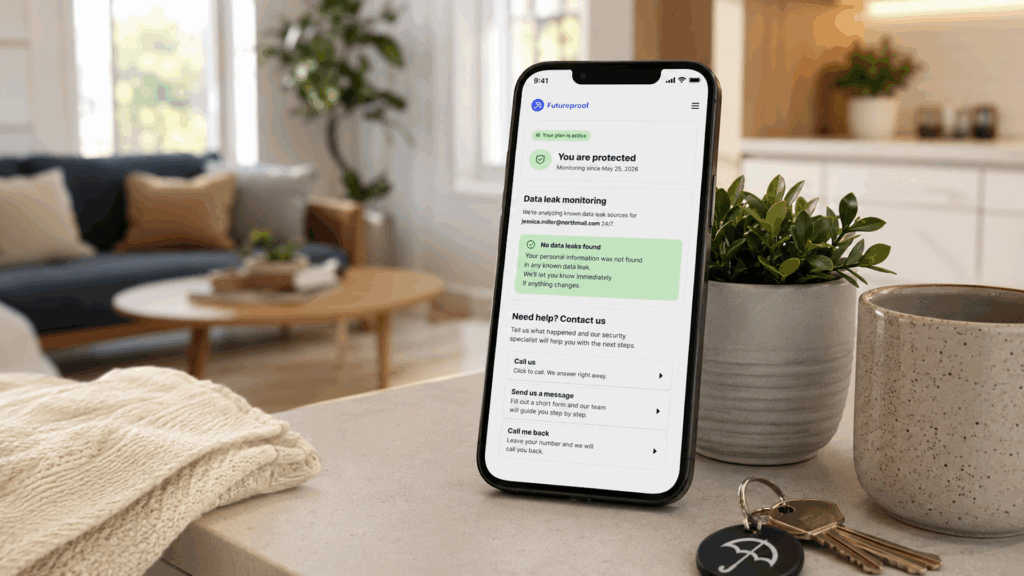
Futureproof monitors your email accounts for data leaks 24/7 and sends alerts the moment your address appears in a leaked database.
But detection is just the starting point.
When something happens, Futureproof tells you exactly what it means and what to do — in plain language, with a real person ready to help.
Here’s what that actually looks like:
- You get an alert that your email showed up in a data leak
- Futureproof explains what it means in detail
- A security specialist walks you through which account to secure first, what to change, and how
- They help you create a strong password and set up two-factor authentication if needed, without assuming you already know what an “authenticator app” is
Futureproof monitors your information for data leaks 24/7 and guides you with clear steps to keep it safer from scams.
Run a free checkWhy It Works for Regular People
Most digital safety tools are designed for people who already understand digital safety. Futureproof is designed for everyone else.
1. You don’t need to interpret a security dashboard
Instead, you get a simple dashboard with your safety status and monthly safety reports that show if your data is safe.
2. You’re not left alone when something feels wrong
Aura has a support team, but it’s focused on fraud incidents after the fact. Futureproof’s security specialists are available anytime — even if you just want to understand what a suspicious email means before you panic.
3. You’re paying for simple and focused protection
With Aura, a big part of what you pay for are tools you may never use — a VPN and antivirus you don’t need often, and identity theft insurance you may not use at all.
Futureproof charges for something more specific: active data leak monitoring 24/7 and real human guidance when you need it. Plus, the Futureproof browser extension is free and useful on its own if you mainly want help managing website permissions.
What Futureproof Doesn’t Do
Futureproof doesn’t offer credit monitoring, antivirus, or a VPN. If those specific features are on your checklist, Aura may be worth the added complexity and cost.
Futureproof is also a newer service — it doesn’t have Aura’s brand recognition or the heavyweight insurance structure.
But for what it sets out to do, Futureproof delivers something Aura doesn’t: actual guidance from digital specialists 24/7 instead of just a notification you’re left to decode on your own.
Aura vs Futureproof at a Glance
| Feature | Aura | Futureproof |
| Email leak monitoring | ✅ | ✅ |
| 24/7 monitoring & alerts | ✅ | ✅ |
| Step-by-step guidance after alerts | ❌ | ✅ |
| Security specialists available anytime | ⚠️ fraud cases only | ✅ |
| Plain-English explanations | ❌ | ✅ |
| 2FA setup guidance | ❌ | ✅ |
| Free browser extension | ❌ | ✅ |
| Built for non-technical users | ❌ | ✅ |
| Credit monitoring | ✅ | ❌ |
| Identity theft insurance | ✅ ($1M+) | ❌ |
| VPN | ✅ | ❌ |
| Antivirus | ✅ | ❌ |
| Password manager | ✅ | ❌ |
Final Takeaway: Is Aura Effective?
Aura is a powerful, well-built platform for people who want a broad safety net and don’t mind navigating a feature-heavy dashboard. If credit monitoring, a VPN, and antivirus are all on your list — it’s worth looking at.
But if your real question is “Is my personal information safe — and what do I do if it isn’t?” — Futureproof answers that better than anything else.
The difference is about which tool actually helps you feel safe, without turning digital security into another job.

At Futureproof, Kevin explains digital safety in simple words, with clear tips and zero fluff. He holds a degree in information technology and studies fraud trends to keep his tips up-to-date.
In his free time, Kevin plays with his cat, enjoys board-game nights, and hunts for New York’s best cinnamon rolls.