Black Friday and Cyber Monday are coming, which means big discounts, crowded inboxes, and a lot of “too good to be true” offers on your screen. It’s also the time when most people get caught — because they’re tired, in a rush, and click too fast.
This article will help you slow down, spot the danger signs, and protect yourself with steps explained in simple English.
Table of Contents
The 3 Biggest Dangers To Look For
Black Friday and Cyber Monday are not just about good prices. They’re also about scammers working extra hard during these events — because they know people are tired, in a hurry, and excited about “big savings”.
Here are the three big things to watch for — in simple words.
1. Fake online stores that disappear after you pay
Here’s what you’ll see:
- The website looks like a real shop.
- Prices that are very low.
- You pay… and never get the item. Or your card is used later for other charges.
2. Scary emails and texts about “your package” or “your payment”
You’ll get messages like:
- “Your package is delayed, click here.”
- “Your payment failed, update your card.”
- “Confirm your account or it will be closed.”
3. Someone quietly getting into your accounts
This one is less visible, but very dangerous. Here’s what it looks like:
- Scammers use old leaked passwords and try them on your email, Amazon, PayPal, bank, or other accounts.
- If one password still works, they can shop in your name or lock you out.
But here’s the good news: with a few simple steps, you can stop most of these problems before they turn into real trouble for your peace of mind or your wallet. Let’s break them down:
1. Write Your “Shopping Plan” on Paper First
Most scams work because people shop in a hurry, jumping from one “flash deal” to another.
What to do
Take a piece of paper and write three short lists:
- Stores I trust
Example: Amazon, Walmart, Target, Best Buy, favorite local chain. - Things I actually plan to buy
Example: headphones, winter coat, a toy for my child. - My total budget
Example: “I will not spend more than $300 in total.”
Keep this paper next to your computer or phone.
How this step protects you
- If a deal comes from a store not on your list, your brain says:
“Wait, I didn’t plan to shop there. Why am I seeing this?” → red flag. - If an offer is for something you never wrote down, that’s impulse + pressure, not a real need.
- If your budget on paper is $300 and your notes show you already spent $280, it’s easier to say “no” to a risky “last deal.”
Scammers expect you to jump. Your paper list makes you pause and think.
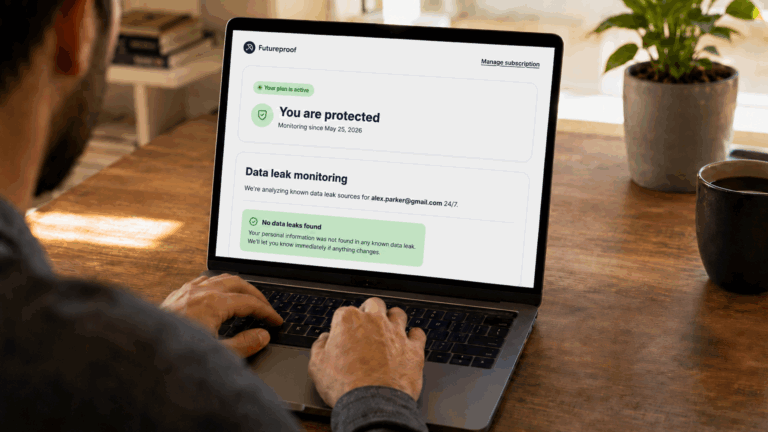
Futureproof keeps your data safer with simple guidance to set a strong password, turn on 2-step verification, and lock down your account.
Check my safety2. Start a Small “Order Notebook” — Your Anti-Scam Radar
Scammers love fake “your order is delayed” or “your parcel is stuck” messages. They sound real, and that’s when most people get caught. Let’s fix that.
What to do
- Take a small notebook or one sheet of paper.
- Title it: “My Orders This Week.”
- Every time you buy something online, write:
- Store name
- Date
- What you bought
- Amount
Example:
- Amazon – Nov 28 – blue sweater – $35
- Walmart – Dec 1 – coffee machine – $79
How to use it
Let’s say you get an email or text that says, “Your package is delayed, click to track” or “Your order for [item] has a problem, update payment”. Your next step is to look at your notebook:
- If the store or item is not written there → treat the message as fake.
- If it claims you bought something you don’t see in your notebook → delete and ignore it.
How this step protects you
Most people try to remember orders “in their head.” Scammers know we forget things — especially when there are many deals around. Your notebook becomes a simple truth check:
‘If it’s not written there, I didn’t order it.’
3. Use One “Online-Only” Card — and Keep It Half-Empty
This tip may come off as obvious, but it’s powerful. Scammers expect that one card holds everything. But you’re quietly breaking that rule.
What to do
- Pick one card you’ll use only for online shops, apps and digital services
- Move a limited amount of money there before Black Friday and Cyber Monday. Example: If your total budget is $300, keep $350 max on that card.
- Use your other cards only in physical stores or for bills.
How this step protects you
If a fake website steals that card number, they can only reach the money on that one card, not all your savings. That’s how your main accounts with larger amounts stay untouched.
With Futureproof, you can get peace of mind knowing your data is protected from data leaks 24/7. Get started today for year-round safety you really deserve.
What To Do If You Think You Clicked the Wrong Thing
If you have already clicked a strange link or entered your details, don’t panic. Just act calmly and quickly:
- Stop using that link or website.
- Close the tab.
- Do not type more information.
- Close the tab.
- If you entered card details:
- Call the number on the back of your bank card.
- Tell them: “I think I entered my card on a fake website.”
- Ask them to watch or block suspicious payments.
- Call the number on the back of your bank card.
- If you typed your password on a strange website:
- Go to the real website (type it yourself, don’t use the link).
- Change your password there.
- Turn on 2-step verification.
- Go to the real website (type it yourself, don’t use the link).
Taking action fast is more important than feeling guilty. Many smart people fall for scams. You’re not alone.
The Bottom Line: When in Doubt, Stay Calm
You don’t have to remember every scam trick. Just remember this:
‘If I did not plan it or if it makes me feel rushed or scared — I slow down and say no.’
Take a breath, close the tab if you’re unsure, and only continue when you feel calm and in control. Real companies will still be there if you come back later — scammers are the ones pushing you to hurry.
Enjoy the deals and keep your calm — we’ve got your back, watching for leaks and warning you when something looks risky.

At Futureproof, Kevin explains digital safety in simple words, with clear tips and zero fluff. He holds a degree in information technology and studies fraud trends to keep his tips up-to-date.
In his free time, Kevin plays with his cat, enjoys board-game nights, and hunts for New York’s best cinnamon rolls.